Some interviews feel rehearsed.
This wasn’t one of them.
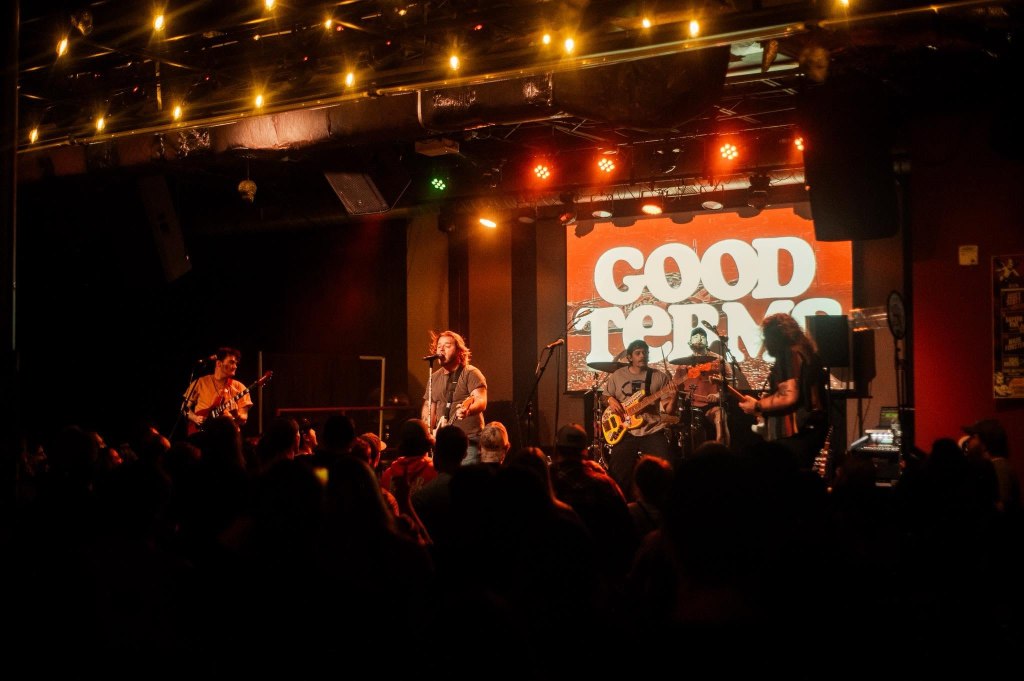
When we caught up with Brian from Good Terms, he was sitting backstage in Colorado Springs preparing for another night on the band’s first full headline tour. His voice was worn down from weeks on the road. The band had already crossed most of the country. Dinner still needed to happen. A show was only hours away.
Yet despite the exhaustion, the conversation never felt rushed.
It felt honest.
The further we got into the interview, the clearer it became that Good Terms isn’t interested in fitting neatly into a single genre label. Emo. Pop-punk. Alternative rock. Rock and roll.
To them, those distinctions matter far less than writing songs that actually mean something.
“We want to dig deep. We want to talk about the things that bother us. We want to write the songs that scare us.”
That philosophy sits at the heart of everything Good Terms does.
Built on Passion, Not Momentum
While many artists point to streaming milestones or viral moments as turning points, Brian described the band’s momentum differently.
For him, it started long before anyone knew the name Good Terms.
The band formed after years of friendship, shared history, and eventually finding themselves in Los Angeles together. What pushed the project forward wasn’t outside validation.
It was belief.
“The momentum has always been internal.”
Even as the world shut down in 2020, the band continued building. Songs were released. Fans slowly appeared. Shows became larger.
Now, years later, they’re watching crowds of over a hundred people scream lyrics back to them across the country.
Not because of a viral moment.
Because they never stopped believing in what they were building.
The Songs That Hurt the Most
One of the rawest moments of our conversation came when Brian discussed songwriting.
Many artists talk about vulnerability.
Brian talked about discomfort.
Specifically, the songs he almost didn’t release.
Several tracks on Burnout explore his relationship with marijuana and the ways it became a coping mechanism during difficult periods of life. Those songs weren’t easy to write.
They weren’t easy to release either.
“I didn’t want to do that. That was embarrassing.”
Then came the realization every songwriter eventually faces:
The uncomfortable songs are often the most honest.
And the most honest songs are often the best ones.
“It was really clear when I was writing the songs. I was like, ‘This is good. This is what the songs that I look up to feel like.’”
Months later, fans would approach him after shows and explain how those same songs helped them navigate their own struggles, sobriety journeys, and personal battles.
That’s when the vulnerability became worth it.
The Beautiful Chaos of Burnout
Listening to Burnout, it’s easy to hear a band refusing to stay in one lane.
There are huge pop-punk choruses.
Heavy breakdowns.
Power ballads.
Moments of aggression.
Moments of reflection.
According to Brian, that wasn’t accidental.
It was experimentation in real time.
“We were really trying to throw everything on the wall to see what was going to stick.”
The band intentionally challenged themselves throughout the writing process.
Can this song be heavier?
Can this one be softer?
Can we add a banjo?
Can we write a two and a half minute guitar solo?
Can we scream this much?
Instead of chasing trends, Good Terms focused on curiosity.
The result is a record that shouldn’t feel cohesive on paper, but somehow does.
And judging by fan response, listeners connected with exactly that.
The Way Live Music Should Feel
Perhaps the most revealing answer of the entire interview came when Brian was asked what he wants fans to take away from a Good Terms show.
His answer wasn’t about inspiration.
It wasn’t about healing.
It wasn’t even about community.
Instead, he talked about responsibility.
About delivering live music the way he believes it should be delivered.
With energy.
With precision.
With spontaneity.
With sweat.
At one point, he laughed about warning fans after shows that he’s completely soaked before taking photos.
Their response?
“Soaked too.”
For Brian, that’s the sign of a successful show.
Not because everyone had the same experience.
But because everyone fully participated in it.
“I think we have a very particular way that we think live music should be done.”
And after watching Good Terms build momentum city after city, it’s difficult to argue with the results.
Looking Ahead
As the conversation came to a close, Brian’s excitement shifted toward the future.
Warped Tour.
Bigger crowds.
More shows.
More opportunities to stand in front of people and exchange energy.
The kind of energy that leaves both the band and the audience exhausted, sweaty, emotional, and wanting more.
For a band that proudly describes itself as simply a rock and roll band, that mission feels refreshingly straightforward.
Write honest songs.
Play them as hard as possible.
And trust that the right people will find them.
Based on what we’re seeing so far, they already are.


Leave a Reply