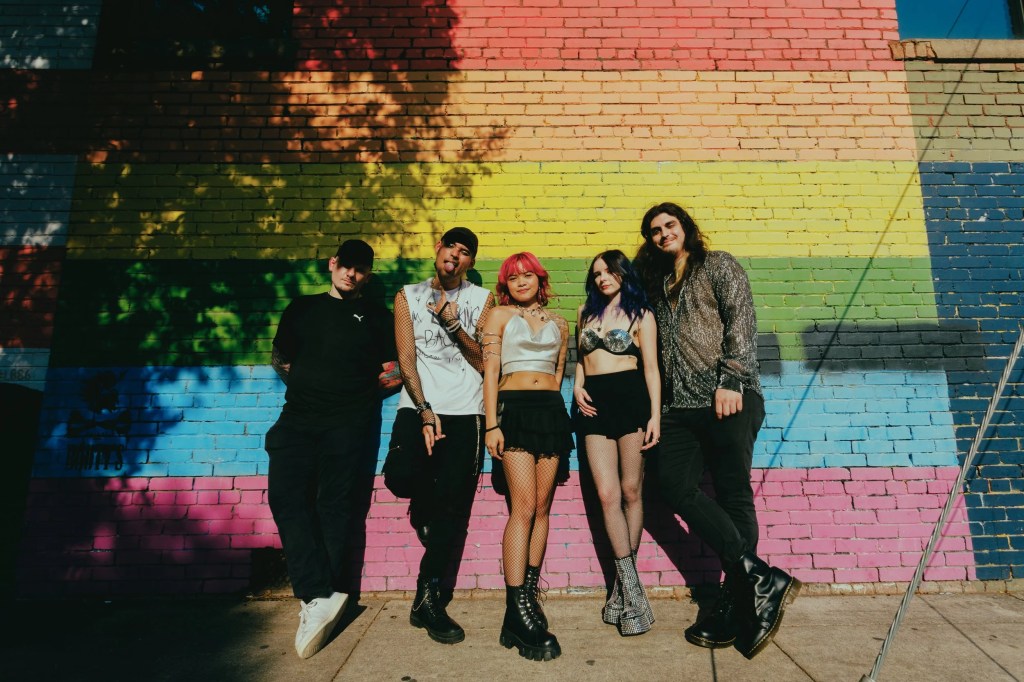
Some artists write songs. Others build worlds.
For Moonstone vocalist Gracie, the goal has never been to fit neatly into a genre box. Instead, Moonstone exists somewhere between vulnerability and empowerment, between emotional honesty and pure fun. It’s a project built on contrasts, where heartbreak can coexist with glitter, where introspection can share the stage with catharsis, and where a room full of strangers can feel like home.
In our conversation with Gracie, we didn’t just talk about music. We talked about fear, vulnerability, creative identity, and the communities that form around art.
The result was one of the most genuine conversations we’ve had so far.
The Paramore Show That Changed Everything
Ironically, Moonstone may have never existed without a cancellation.
After stepping away from releasing music for several years, Gracie wasn’t sure she was ready to put herself back out into the world. While her husband Lucas continued writing and producing, she focused on other aspects of her career and wrestled with the vulnerability that comes with creating.
Then a planned anniversary trip to see Paramore took an unexpected turn.
The original show was canceled due to COVID concerns, but a chance opportunity led the couple to Austin City Limits, where they finally saw Paramore perform.
That experience changed everything.
Seeing a band successfully blend alternative music, pop melodies, emotional songwriting, and visual artistry helped Gracie realize she didn’t have to choose one lane.
She could build something that incorporated all of it.
And Moonstone was born.
“I Love Contrast”
Throughout our conversation, one theme appeared again and again: contrast.
Moonstone’s music balances emotional depth with infectious melodies. Their live performances invite audiences to scream lyrics one moment and dance the next. Even their visual identity embraces duality.
Sparkles.
Fishnets.
Alternative fashion.
Feminine aesthetics.
Rock energy.
It’s all intentional.
“I love contrast. I love that you can be two things at once, you don’t have to stick to one thing.”
That philosophy feels woven into every part of Moonstone’s identity.
The band’s self-described “sad pop” sound combines alternative and pop-punk influences with catchy hooks and deeply personal lyricism. The result feels familiar while still carving out its own space.
Writing From Real Life
One of the most refreshing parts of our conversation was Gracie’s honesty about her songwriting process.
There’s no elaborate mythology. No carefully manufactured persona.
Most songs begin with a journal.
Gracie regularly writes down her thoughts, experiences, and emotions before transforming them into lyrics. Some songs come directly from her own life. Others are inspired by people she loves and experiences she’s witnessed firsthand.
For her, songwriting isn’t separate from life.
It’s an extension of it.
“I have to be writing about something that’s happened to me, or that is happening to me, or something I’ve experienced.”
That raw honesty explains why Moonstone’s music feels so personal. The songs aren’t reaching for authenticity, they’re built from it.
Creating Safe Spaces
One of the most powerful moments of our conversation came when Gracie described the meaning behind the song “In My Room.”
At face value, it’s a song about being an introvert and finding comfort in your own space.
But over time, its meaning evolved.
The “room” became bigger than four walls.
It became a metaphor.
A safe space.
A community.
A place where people can exist exactly as they are.
That idea extends far beyond the music itself. Whether it’s encouraging fans to dress in sparkles and fishnets for album release shows or creating immersive live experiences, Moonstone is intentionally building an environment where people feel welcome.
Where vulnerability isn’t weakness.
Where self-expression isn’t judged.
Where people can simply exist.
More Than A Band
As our conversation wrapped up, Gracie spoke passionately about Moonfest, the band’s self-created festival celebrating artists throughout the Dallas music scene.
The event isn’t just about Moonstone.
It’s about community.
It’s about giving local artists opportunities.
It’s about creating something larger than themselves.
That philosophy perfectly mirrors everything else we discussed.
Moonstone isn’t simply trying to release songs.
They’re creating spaces.
Spaces for connection.
Spaces for expression.
Spaces where people can scream, dance, heal, and belong.
And in a world that often feels increasingly disconnected, that might be exactly what makes Moonstone special.
 MISFIT MAGAZINE
Leave a comment